
Why Choose an ELCB Circuit Breaker for Global Projects?
Why Choose an Elcb Circuit Breaker for Global Projects?
Global electrical projects face more than different voltages and plug designs. They face varied grounding systems, climates, regulations, installation habits, and maintenance standards. An Elcb Circuit Breaker can help detect leakage current and disconnect power before a small insulation fault becomes a serious safety event.
Electrical safety specialist John Cadick expresses a practical principle: “Protection works only when it is correctly selected, installed, and tested.” This principle matters on construction sites, solar farms, commercial buildings, and industrial facilities. A device may perform well in a laboratory, yet fail to provide dependable protection when the system type or residual-current rating is misunderstood.
Details matter.
Project engineers should verify the supply voltage, frequency, pole configuration, trip sensitivity, breaking capacity, and compatibility with TT or TN earthing arrangements. They should also review IEC requirements and the destination market’s certification rules. Moisture, dust, heat, vibration, and unstable maintenance routines can influence product selection.
An Elcb Circuit Breaker is not a universal shortcut. It needs correct coordination with protective devices and a suitable testing schedule. Manual test buttons should be checked during commissioning and routine maintenance. Records should remain clear, especially when several contractors share responsibility.
There is also room for honest reflection. Many projects focus on purchase price first. That approach can overlook nuisance tripping, replacement delays, or difficult access inside crowded distribution boards. A carefully specified breaker may cost more initially. It can still reduce operational risk over the project’s working life.
For global applications, dependable protection begins with local technical review, documented testing, and realistic site conditions. Safety should travel with the project, not remain behind in the design office.
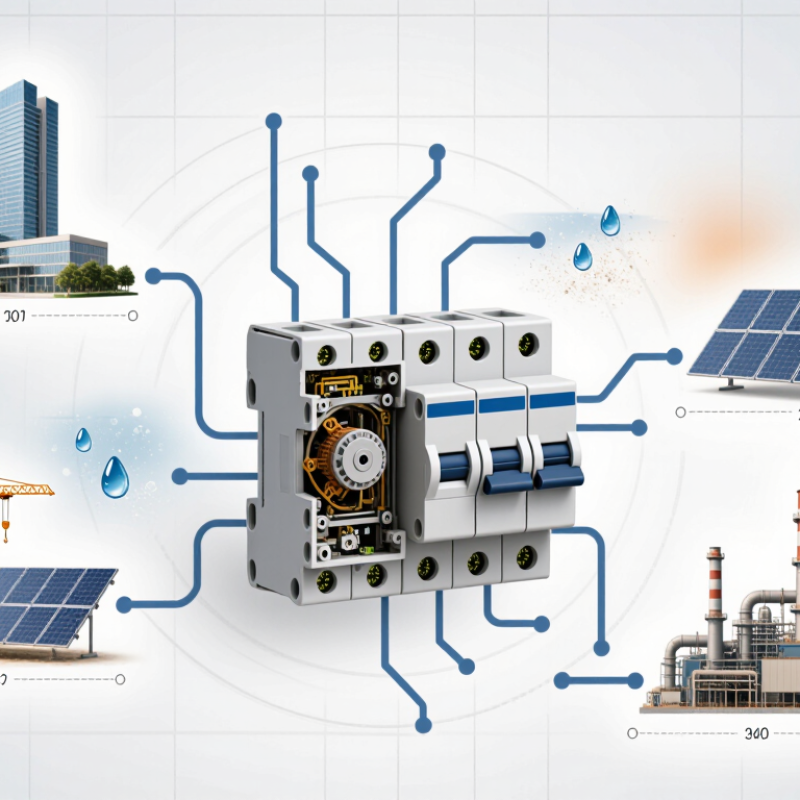
What Is an ELCB Circuit Breaker?
What Is an ELCB Circuit Breaker?
An ELCB circuit breaker detects leakage current flowing from live conductors to earth. It disconnects the circuit before a fault becomes a serious shock or fire hazard. The term ELCB is often used loosely. Modern installations usually use current-operated RCDs or RCCBs, covered by IEC 61008-1 and IEC 61009-1. Older voltage-operated ELCBs work differently and are rarely suitable for new global projects. This distinction matters. A device can carry the ELCB label without offering identical protection. The International Electrotechnical Commission also requires automatic disconnection principles in IEC 60364-4-41. Meanwhile, NFPA reported 1,504,500 fires in the United States during 2022. Not every fire involved electrical leakage, but the figure shows why fault protection deserves careful design.
Selection requires more than choosing a sensitivity rating. Engineers should check system voltage, frequency, earthing arrangement, pole configuration, trip time, and short-circuit capacity. A 30 mA device commonly supports additional protection against electric shock. It does not replace overload protection unless combined with suitable overcurrent protection. In practice, nuisance tripping can occur with long cables, filters, or variable-speed equipment. That is where project assumptions sometimes fail.
Tips: Confirm local code acceptance before procurement. Match the device to the site earthing system. Test the unit using its test button during commissioning and planned maintenance. Record trip results. A small label review can prevent a costly specification mistake.
| Data Dimension | Verified Technical Information | Why It Matters for Global Projects | Selection or Installation Note |
|---|---|---|---|
| Basic Definition | An ELCB, or Earth Leakage Circuit Breaker, is a protective device that disconnects a circuit when leakage to earth creates a dangerous condition. In modern installations, the term commonly refers to a residual-current device, also called an RCD or RCCB. | It reduces the risk of electric shock and electrical fires caused by insulation failure or current flowing through an unintended path to earth. | Confirm the terminology required by the local electrical code, because “ELCB” may describe different technologies in different markets. |
| Current-Operated Protection | A modern residual-current ELCB monitors the balance between the live and neutral conductors. If the difference exceeds the rated residual operating current, it trips the circuit. | This operating principle is suitable for many single-phase and three-phase systems and does not depend on a dedicated earth electrode voltage signal. | Install all relevant live conductors through the sensing device. The protective earth conductor must not pass through the residual-current sensor. |
| Voltage-Operated ELCB | Older voltage-operated ELCBs detect a voltage rise between the equipment frame and earth. This technology is less common in new installations. | Recognizing the difference prevents incorrect replacement or coordination when upgrading equipment across countries with different wiring practices. | For new projects, use the device type specified by the applicable national standard and project engineer rather than relying only on the name “ELCB.” |
| Primary Protection Function | An ELCB/RCCB provides residual-current protection. It generally does not provide overload or short-circuit protection unless it is a combined RCBO. | Separating protection functions makes system design clearer and allows the correct coordination with miniature circuit breakers, fuses, or molded-case circuit breakers. | Use an RCBO when residual-current, overload, and short-circuit protection are required in one outgoing circuit. |
| Common Residual Operating Ratings | Common sensitivity values include 10 mA, 30 mA, 100 mA, and 300 mA. A 30 mA device is widely used for additional protection against electric shock in suitable final circuits. | A range of sensitivities supports different applications, from personal protection to leakage-current and fire-risk protection at distribution levels. | Select the rating according to the local code, system leakage, equipment characteristics, and the required level of protection. Lower sensitivity is not automatically better. |
| Typical Poles | Devices are available in configurations such as 2-pole for single-phase circuits and 4-pole for three-phase circuits with neutral. | The available pole arrangements support common residential, commercial, industrial, and infrastructure distribution systems. | Switch all conductors required by the applicable wiring rules. A neutral conductor must not be shared downstream between separately protected residual-current circuits. |
| Residual Current Types | Type AC detects sinusoidal alternating residual current. Type A also detects pulsating direct residual current. Other types are intended for systems that may produce smoother or higher-frequency residual components. | Correct current-type selection improves compatibility with modern loads such as electronic power supplies, variable-speed drives, chargers, and renewable-energy equipment. | Match the device type to the connected load and project specification. Do not replace a specified higher-capability device with a basic AC-type device without engineering approval. |
| Rated Current | The rated current of an ELCB/RCCB indicates the continuous current it can carry under specified conditions. Typical commercial ratings include 25 A, 40 A, 63 A, 80 A, and 100 A, depending on the product range. | Correct sizing supports safe coordination with upstream protection and prevents the device from being used beyond its continuous current capability. | Rated current is not the same as residual operating current. Verify both values, along with voltage, frequency, utilization category, and short-circuit coordination. |
| Operating Time | Residual-current devices are designed to disconnect within specified time limits when the residual current reaches defined multiples of the rated operating current. Exact limits depend on the device standard and product class. | Standardized trip behavior supports predictable protection performance and discrimination planning across international projects. | Check the manufacturer’s test data and the applicable standard. Time-delayed or selective devices may be required upstream to reduce unwanted tripping. |
| Applicable Standards | Common international references include IEC 61008 for residual-current circuit breakers without integral overcurrent protection and IEC 61009 for RCBOs. Local adoptions may use different designations. | Standards-based documentation simplifies technical approval, inspection, tender comparison, and acceptance testing in different jurisdictions. | Confirm the current edition and national adoption required at the project location. Certification markings alone do not replace a complete compliance review. |
| Global Project Advantages | An ELCB/RCCB can provide a consistent residual-current protection strategy for buildings, industrial facilities, temporary installations, data-related infrastructure, and utility support systems. | It can improve personnel safety, support standardized panel designs, simplify maintenance procedures, and help satisfy safety requirements in multiple markets. | Standardize the protection philosophy, but allow the final ratings and device types to follow local voltage systems, earthing arrangements, load profiles, and regulations. |
| Limitations | An ELCB does not prevent every electrical hazard. It may not trip for a line-to-neutral short circuit if the current remains balanced, and it cannot replace proper insulation, earthing, bonding, overcurrent protection, or safe work procedures. | Understanding limitations helps prevent false confidence and supports a complete protection system rather than relying on a single device. | Combine residual-current protection with overcurrent protection, protective earthing, equipotential bonding, suitable enclosures, and regular inspection. |
| Testing and Maintenance | Most residual-current devices include a test function that simulates an imbalance. The test button should be operated according to the installation instructions and local maintenance requirements. | Routine testing helps identify mechanical, electrical, or installation problems before they affect personnel safety. | Record test results, investigate nuisance tripping, and use calibrated test equipment when formal verification of trip current and operating time is required. |
| Recommended Selection Checklist | Review system voltage and frequency, earthing arrangement, number of poles, rated current, residual operating current, residual-current type, short-circuit coordination, environmental conditions, and applicable certification. | A documented checklist reduces specification gaps and improves consistency between design, procurement, installation, and commissioning teams. | Approve the final device only after checking the single-line diagram, load schedule, coordination study, local regulations, and manufacturer technical documentation. |
Note: Technical values and device classifications can vary by product standard, national code, earthing system, and application. Final selection should be verified by a qualified electrical professional.